An Author Visits and Reflects
By Richard Graham Author of At the Emperor's Pleasure
Zhoushan is an archipelago of some 400 islands to the southeast of Shanghai. The smallest of these islands are scattered randomly across the western edge of the East China Sea where the tidal forces of this capricious sea have, since time began, braced themselves to confront the cavernous mouth of Hangzhou Bay and the outflow of the mighty Yangtze River Delta.
Qingbang is one such island. It is small, a mere one and a half miles from north to south and just half a mile wide. In May of this year, I stood close to the edge of the island’s north eastern cliffs and looked out to sea. If a ship were to sail along my direction of sight, it would travel close to 400 miles before it encountered its first landfall in the form of Japan's Goto Islands off the coast of Nagasaki. A mere four miles along that same line lies the wreck of the Lisbon Maru, since October 1942 the maritime tomb for several hundred British prisoners of war. Which is why I stood where I did in quiet reflection.

I was there as one of several British guests of the Chinese government. Most guests were family descendants of those POWs who had either perished or survived when the merchant ship carrying them from Hong Kong to work as slave labour in Japan had been tragically sunk by an unsuspecting American submarine. Amongst the descendants were a brother and sister who owed their very existence to the survival of their grandfather and to those who had rescued him from the sea. Of the 1816 men on board, 828 died that grim day, some locked down in the ship's holds by their captors, others run down or shot in the sea. A further 200 or more survived but never fully recovered and died within a few months.
My status as a grateful guest had its own explanation. My book At the Emperor's Pleasure shows Japanese occupied China of the 1940s in a deservedly good light, with the consequence that both book and author are approved by the Chinese authorities. The book pays appropriate and special tribute to the many fishermen of Qingbang and its closest neighbour Miaozihu who on 2nd October 1942 courageously launched their sampans to rescue 384 survivors from under the noses of their feared oppressors. The longest survivor amongst those fishermen, Lin Agen, only 17 years old at the time of the tragedy, died in 2020, aged 95.

When the Lisbon Maru incident was brought to President Xi Jinping's attention in 2024, he promptly ordered a memorial to be put in place. It was unveiled just a year later. That's how things work in China. The memorial has been purposely sited at the north east tip of the island so that anyone paying respect to those it commemorates may look directly out to sea towards where the Lisbon Maru now lies on the seabed and picture for themselves the scene as Qingbang's fishermen went about their gallant rescue mission all those years ago.
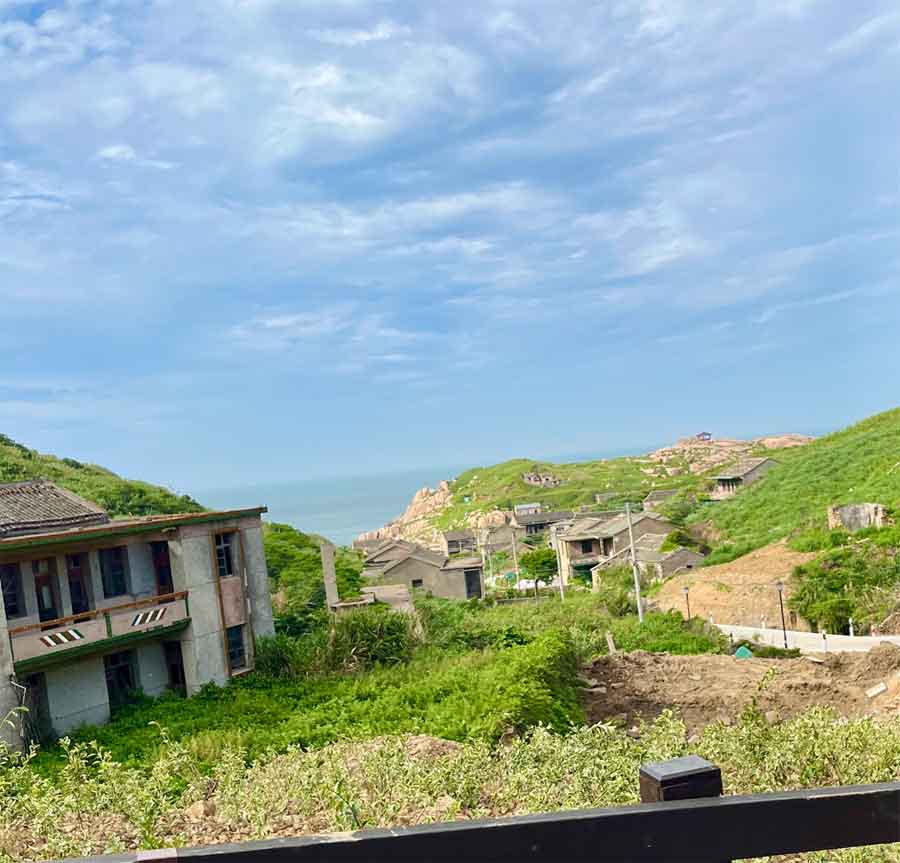
Our party was put ashore at Xifengwan wharf on Qingbang's east coast, a two hour boat trip from Zhoushan City. From there we headed northwards in open sided, electric minibuses named Guanguangche. We passed through a clutch of abandoned, derelict homes, a sad hint of times past when most islanders fished for a living. Some still do, but tourism, including leisure fishing, is now at the heart of the island's economy.
The made up narrow lane soon gave way to the rocks and scrub of the climb up to the exposed headland, so it was a shanks pony plod to reach the site of the memorial. We gathered there, no doubt each of us with our own thoughts and emotions. Wreaths and floral tributes were laid. Far beneath us, the sea was going about its eternal negotiation with the island's east coast cliffs. In the calm of a mid May afternoon, the waves were nudging themselves gently ashore, scarcely hinting at how hazardous it had been for those POWs who on 2nd October 1942 had somehow survived the swim from the doomed Lisbon Maru only to be confronted by a malevolent surf that threated to dash them ruthlessly onto the rocks.

It was down there, I couldn’t be sure precisely where, all those 84 years ago that Signalman Arnold Topliff, a champion swimmer in his native Derby, had launched himself from one of those rock ledges into the sea and dragged ashore an exhausted, close to drowning Captain Christopher Man of the Middlesex Regiment (Duke of Cambridge's Own) whose story, and that of his young wife Topsy, herself a prisoner of the Japanese in Hong Kong, is told in my book. Christopher was one of several survivors who, already weakened by months of malnutrition as POWs in Hong Kong and the last two days at sea without food or sleep, had somehow made it across four miles of sea to Qingbang and its neighbouring islands.
Behind me, half a mile up and over the spine of the island then down to sea level on the island's western coast, is a beach where the rescued had been put ashore before being led to whatever shelter, food and care was possible within the Qingbang community. For those survivors, the relief felt for the remainder of that day and night was yet to be troubled by the dawning inevitability that the Japanese would come looking for them. As they did, the very next day. Under threat of the dire consequences to themselves and their temporary hosts, the survivors were ordered to gather on the same beach where they had climbed ashore. All but three of the survivors were gathered up and shipped via Shanghai to Japan where as yet unknown horrors awaited them. And the three? They hid in a cave, within calling distance from where I stood, reflecting on the story of all this.

Later that day, together with descendants of the fishermen, we took part in planting a tree as a token of China UK friendship. Looking back on it now prompts the following thoughts.
The Lisbon Maru memorial on Qingbang is meant as a tribute to the fishermen whose gallantry and humanity are officially portrayed as an exemplar of China UK friendship and wartime camaraderie in the fight against fascist tyranny. But here's the thing. Whilst I fully understand and accept the current geopolitical context for that narrative, I have to add that my presence in Qingbang last May and my thoughts that day as I stood looking around me and out to sea require further nuance. For one thing, few if any of those Zhoushan fishermen who set out from their island shores that historic day had any idea who they were trying to rescue. I doubt they gave any thought to wartime alliances of convenience or necessity between nations. All they knew was that there had been gunfire and many men were in trouble in the sea. That was enough. Their action was an example of pure humanity; simple as that, and dare I suggest, the more awe inspiring for that.
And here's a further thought. As I contemplated the memorial and later looked out to sea towards the site of that sad maritime tomb, it was those who had perished that tragic day in October 1942 and those who had survived who were on my mind every bit as much as the brave fishermen of Qingbang. I had met and known a few of those survivors in my early years as a young regimental officer. They never spoke of their ordeal, but those of us who followed them into the regiment knew of it. And many of us, like me, offered them and those who never made it back home a silent pledge that we would not let them down as their successors. And I would like to think that such inner vows made many of us turn out to be better men than we might otherwise have been.

Our generous hosts had organised an impressively varied programme for our visit over five days, thereby giving us a tantalising and impressive glimpse into the region's history, culture and current way of life. But for me, and I guess for those descendants of the Lisbon Maru POWs with whom I shared this pilgrimage, it had been the simple act of standing on that small, rocky promontory in Qingbang, each of us in their own, private communion across the decades with brave, simple fishermen, and with those they had saved and those who had been beyond saving, that will remain the longest and clearest in our memories.
Read more about our 2026 Visit to Zhoushan from other members of the group.




Click image to expand and see all images