The Journey of a Radio Message
From Thomas Banham a survivor of the Lisbon Maru
Among the surviving traces of Warrant Officer II Thomas Banham’s wartime experience is something unusually personal, a recording of his message while in captivity.
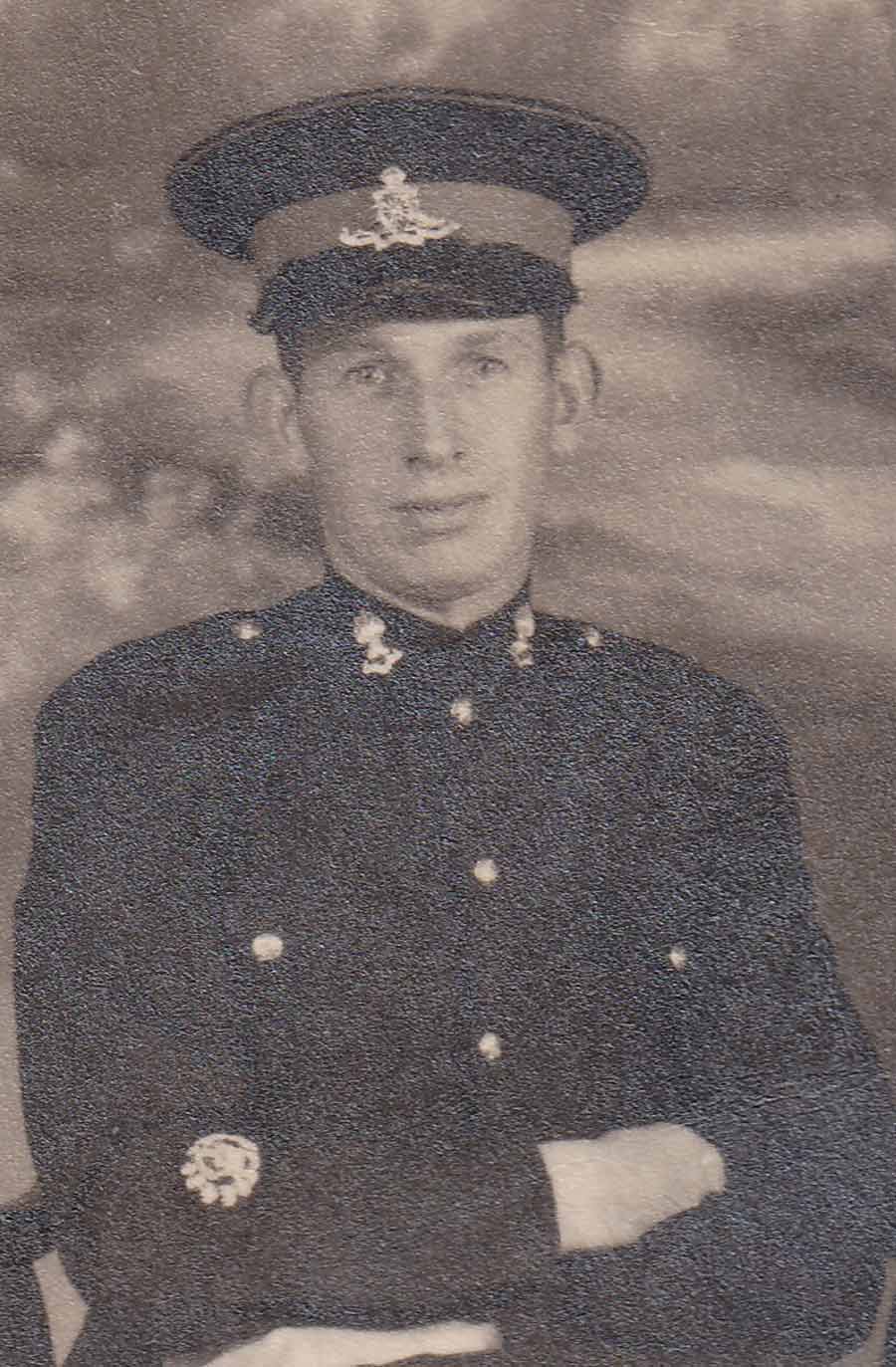
Thomas Banham
Tom Banham had been captured following the fall of Hong Kong. In October 1942 he survived the sinking of the Lisbon Maru, the Japanese transport ship carrying Allied prisoners of war from Hong Kong. He was subsequently held as a prisoner of war in Osaka, Japan, where he died shortly before the end of the war.
The recording, which survives today, appears to preserve a radio message transmitted by Tom from captivity. Its survival allows us to follow not only Tom’s story, but the remarkable journey by which a few words spoken in a Japanese prisoner-of-war camp could cross the world and eventually reach his family, a family scattered by war.
The story begins with the evacuation of civilians from Hong Kong as Japanese forces advanced in 1941. Tom’s wife, Nancy, and their children, Reginald and Margaret, escaped from Hong Kong with other civilian families. Their journey took them through the Philippines and Australia before they eventually returned to Northern Ireland. While they were in Australia, Nancy worked in a munitions factory and the children attended boarding school.
Meanwhile, information about Tom was making its own difficult journey. The War Office sent notification to the family home in Northern Ireland that he was a prisoner of war in Osaka. Although Nancy and the children were then in Australia, the information eventually reached her and correspondence between husband and wife began.
A surviving postcard demonstrates the complications created by the family’s movements. Tom sent a card addressed to Nancy in Australia, apparently before he knew that she had left for Northern Ireland. The material preserved with the family records shows how correspondence could follow recipients across continents, sometimes arriving only after they had moved again.
A further surviving notice, dated 16 January 1945, relates to the postcard from Tom. The actual card had been sent to Moonee Ponds in Melbourne and was subsequently forwarded.


Voices from Captivity
Letters and postcards were not the only way in which prisoners in Japanese hands were occasionally able to communicate. Accounts cited in the family research describe prisoners being permitted to make shortwave radio broadcasts. Such broadcasts may have served Japanese propaganda purposes, but they also created an unexpected opportunity for contact with families thousands of miles away.
Listeners in countries including the United States, Australia and New Zealand monitored these transmissions. Some did more than simply listen. They wrote to prisoners’ relatives with details of what they had heard, and in some cases recorded the actual voices onto discs which could then be sent to the families concerned.
The scale of this listening effort was considerable. The research accompanying the recording of Tom's message, notes that organised monitoring in New Zealand is estimated to have intercepted around 6,000 prisoner-of-war messages between 1941 and 1945. For families desperate for news, even a brief intercepted message could be immensely important. In Tom Banham’s case, somebody appears to have gone further still.
The Surviving Disc
The physical object preserved with the Banham family material is a disc made for a Wilcox-Gay Recordio home recording machine on a 78 rpm lacquer-coated cardboard disc, played with a steel needle. The evidence suggests that it is not a later commemorative recording, but may be the contemporary disc onto which Tom’s wartime message was recorded.
An annotation associated with the recording reads:
"Tom Banham message {read} {rec’d} by Ann Butler {Bussler?} 21 May 1945 reg’d #3082. sent from Japan."
The precise interpretation of this note remains uncertain. The name of the person who received or recorded the broadcast is not completely clear, and 21 May 1945 may be the date on which the transmission was intercepted or registered rather than necessarily the date on which the message was recorded. The registration number, “3082”, may also offer a clue to the organisation or individual responsible for monitoring the broadcast, although the surviving material does not establish its meaning. Whoever recorded it, however, preserved something precious, Tom’s personal message to his family.
The family of Thomas Banham still have the original disc and copies of it that were initially transferred to a reel of tape from an early reel to reel tape recorder, and then to a tape cassette, and ultimately, to an MP3 file which then allowed some digital enhancement.
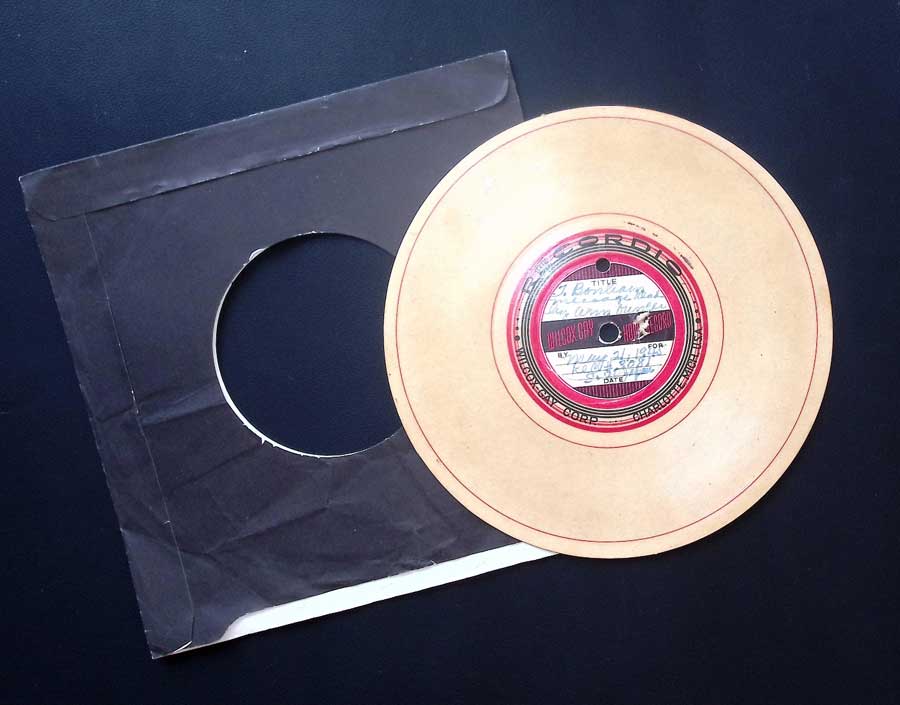
Listen to the audio of Thomas Banham's personal message
The Transcription
A transcription of the audio which accompanied the disc in the Banham family material reads:
Tom Banham message {read} {recd} by Ann Butler {Bussler?} 21 May 1945 regd # 3082. sent from Japan
How about putting on an air mail stamp on this, and sending [the card] to Mrs N Banham B A N H A M Mrs N Banham, 24 Robert Street, Waterside, Londonderry, Northern Ireland.
This was written by her husband T Banham, Royal Artillery, formerly of Hong Kong with {narrow targeting} [inaudible]
{our men} {stone} [inaudible] are very well
Hope all at home are well I am always thinking of you, Reggie and Margaret. I have had received 20 letters from you, I’d like a photo of you all. I hope with all the people gathered around too.
The following [inaudible] my family and relations R Elliot, R Bullover , {J nnn} R Gory, O Mull, hope Bobby, Tommy and Harold are all right and remain {totally safe}
Much love to all above, to Reggie and Margaret and [inaudible] give you all a hug I hope all my love and kisses hoping for a quick reunion your loving husband.
Thanks for helping {xx that one} everyone by passing it to Mrs N Banham
24 Robert Street Waterside, Londonderry, Northern Ireland
This is her husband in the Osaka Camp, T Banham, Royal Artillery, formerly a [2 seconds inaudible] must be going now
Reception was poor and parts of the recording are obscured by static, making some words impossible to identify with certainty. The surviving transcription therefore includes several passages marked as inaudible. What can be heard is deeply personal. Tom refers to receiving around twenty letters from Nancy and asks for a photograph of the family. He says that he is always thinking of Nancy, Reggie and Margaret. He sends greetings to relatives and friends and ends with words of affection for his wife and children:
"Much love to all above, to Reggie and Margaret... all my love and kisses hoping for a quick reunion."
The recording also includes an appeal for whoever was listening to pass the message on to Mrs N. Banham in Waterside, Londonderry, Northern Ireland. What is beyond doubt is the purpose of the message. A prisoner in Osaka was trying to reach his wife and children on the other side of the world. Somewhere, an unknown listener heard him. That person recorded the transmission and preserved it.
The Reunion That Never Came
The final words of the message are particularly poignant because the reunion Tom hoped for never came. The surviving family material records that Thomas Banham died on Saturday, 11th August 1945. He had survived the fall of Hong Kong, the sinking of the Lisbon Maru and years of captivity, only to die shortly before the war ended.
Today, the surviving recording connects those events with something much more intimate. Official documents can tell us where a prisoner was held. Lists can record who survived a shipwreck and who did not return home. Letters and postcards can preserve words written many decades ago.
But this disc preserved a personal message originally transmitted by Tom himself.
For a few moments, across the static of a wartime shortwave broadcast, Thomas Banham was able to speak directly to Nancy, Reggie and Margaret.
More than eighty years later, his message has completed another journey, from a prisoner-of-war camp in Osaka, through an unknown wartime listener and a home recording machine, into the surviving history of the men of the Lisbon Maru.
Worth noting that Tom believed his family was in Australia, as we can see from the postcard that was forwarded to Northern Ireland. His wife then contacted him in Japan to say that they were in Northern Ireland and the radio message gave the Northern Ireland address. The card was dated post Xmas 1944 and the radio message 21 May 1945. Presumably the new address for his wife crossed in the post.
Read more about Thomas Banham's Personal History, or return to the LiMMA website for further information on the men's imprisonment in Hong Kong and their experience of the sinking of the Lisbon Maru.